

Triple Yahtzee
Triple Yahtzee was the first significant variation to the original game, adding a strategic twist while keeping the core mechanics intact. Players juggle three concurrent games, scoring in columns with multiplying bonuses for a higher final score. Despite taking longer to play, this added complexity enhances the appeal for many, providing a new challenge and sharpening math skills. Triple Yahtzee has stood the test of time as a popular variant, blending familiar fun with innovative strategy.
Three Times the Fun!

What is Triple Yahtzee? The original Yahtzee spin-off was launched in 1972, with promises of three times the fun. Discounting that Travel Yahtzee, which was simply a smaller version of the original, had been released two years earlier, Triple Yahtzee was the first true derivative game. It included a new layer of strategy but kept the overall changes rather modest, maintaining the same basic format as traditional Yahtzee.
Triple Yahtzee rules involve what is essentially playing three games of Yahtzee at once. The player may score a turn on any one of three game columns of their scorecard. This becomes a tactical decision as the Game 2 total score is doubled, and Game 3 is tripled. The totals of all three games are then added together for the final score. Recording high-point scores in Game 2 or Game 3 where they will be multiplied is therefore of paramount importance to obtain the highest score.
New players are sometimes frustrated that a Triple Yahtzee game takes three times longer to play than the original, but for others that is part of the allure. The game also formally introduces multiplication to the Yahtzee scorecard for the first time, helping to keep math skills sharp. As the first foray into a Yahtzee dice game derivative, Triple Yahtzee succeeds in appealing to fans of the original game while successfully adding a new layer of strategy. It remains one of the most popular variants ever produced.
Triple Yahtzee Editions
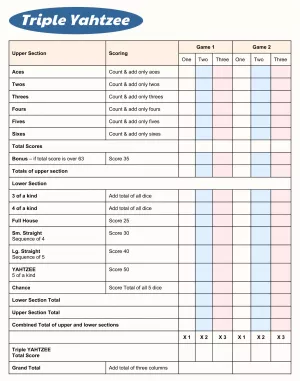
Triple Yahtzee
Score Card – unofficial
- Homebrew
United States
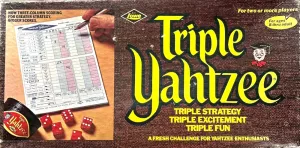
Triple Yahtzee
1972 - E.S. Lowe Company
United States
Triple Yahtzee
1972 - E.S. Lowe Company
United States
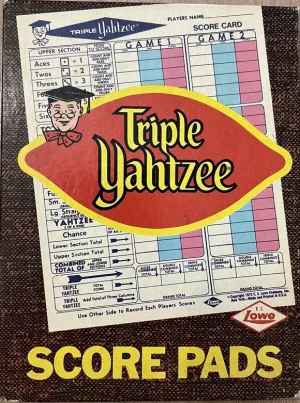
Triple Yahtzee
Score Pads
1972 - E.S. Lowe Company
United States
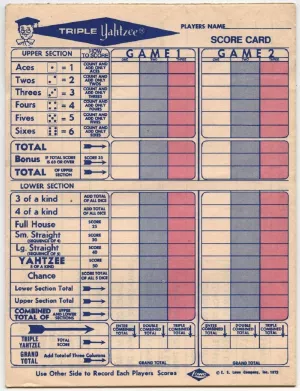
Triple Yahtzee
Score Card
1972 - E.S. Lowe Company
United States
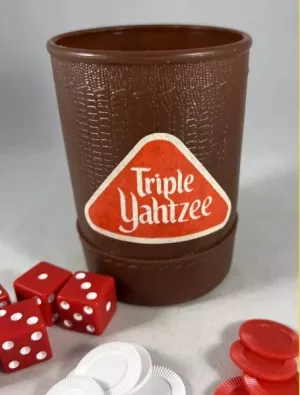
Triple Yahtzee
Dice Shaker
1973 - Milton Bradley
United States
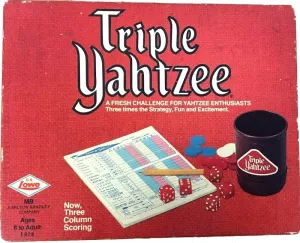
Triple Yahtzee
1973 - E.S. Lowe Company
United States
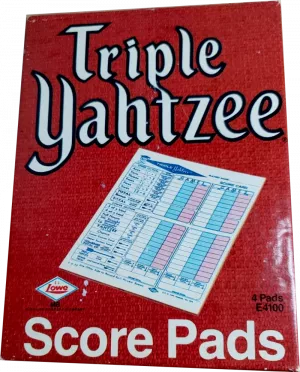
Triple Yahtzee
Score Pads
1973 - E.S. Lowe Company
United States
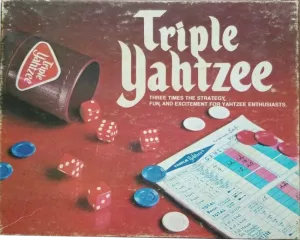
Triple Yahtzee
1975 - E.S. Lowe Company
United States
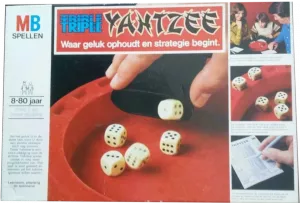
Triple Yahtzee
1978 - Milton Bradley
Netherlands
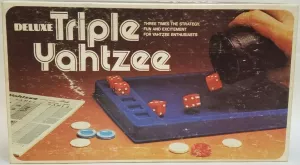
Triple Yahtzee
1978 - Milton Bradley
United States
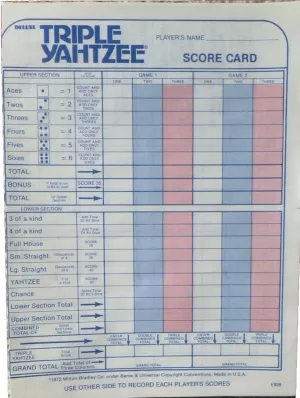
Triple Yahtzee
Deluxe Edition Score Card
1978 - Milton Bradley
United States
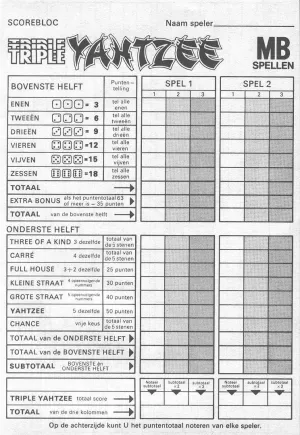
Triple Yahtzee
Score Card
1978 - Milton Bradley
Netherlands
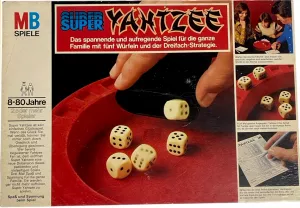
Triple Yahtzee
"Super Yahtzee"
1979 - Milton Bradley
Germany
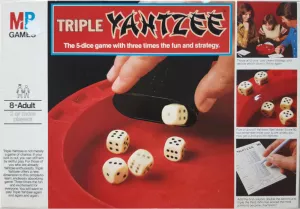
Triple Yahtzee
1981 - Milton Bradley
United States
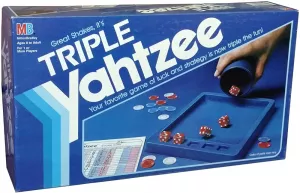
Triple Yahtzee
1982 - Milton Bradley
United States
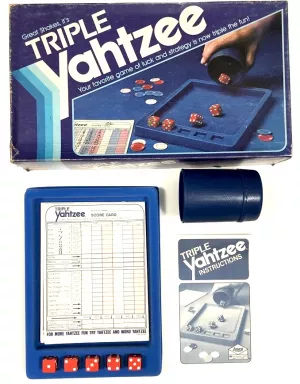
Triple Yahtzee
1982 - Milton Bradley
United States

Triple Yahtzee
Dice Shaker
1982 - Milton Bradley
United States
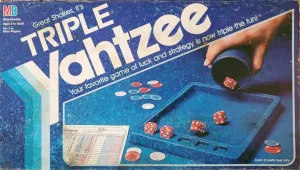
Triple Yahtzee
1991 - Milton Bradley
United States
Triple Yahtzee Rules & Score Cards
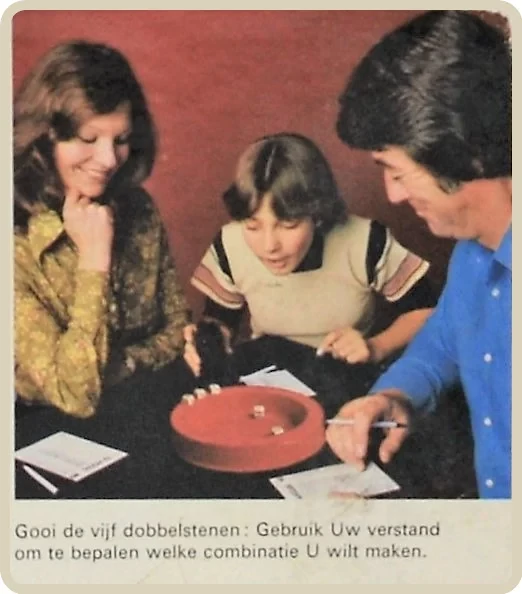
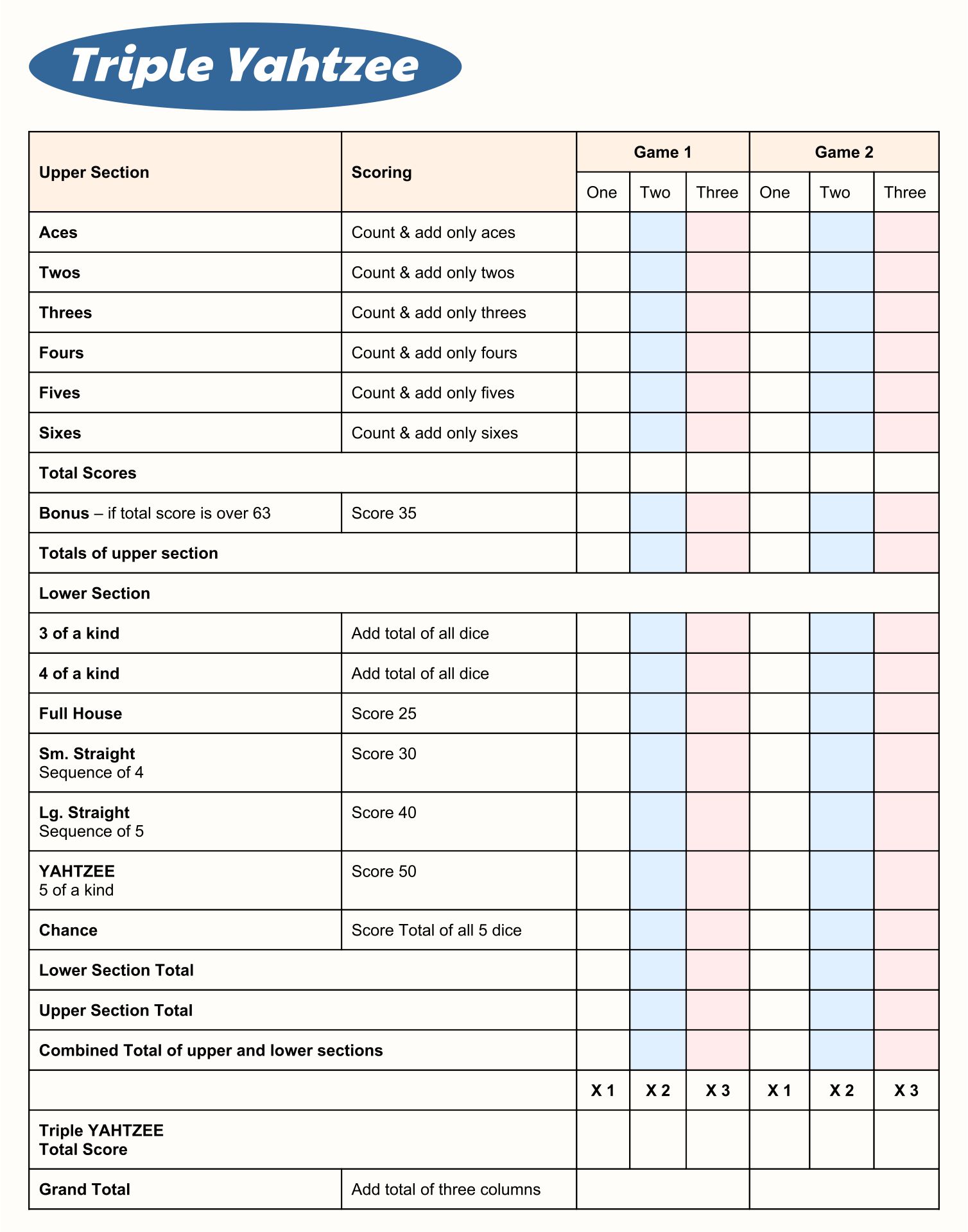
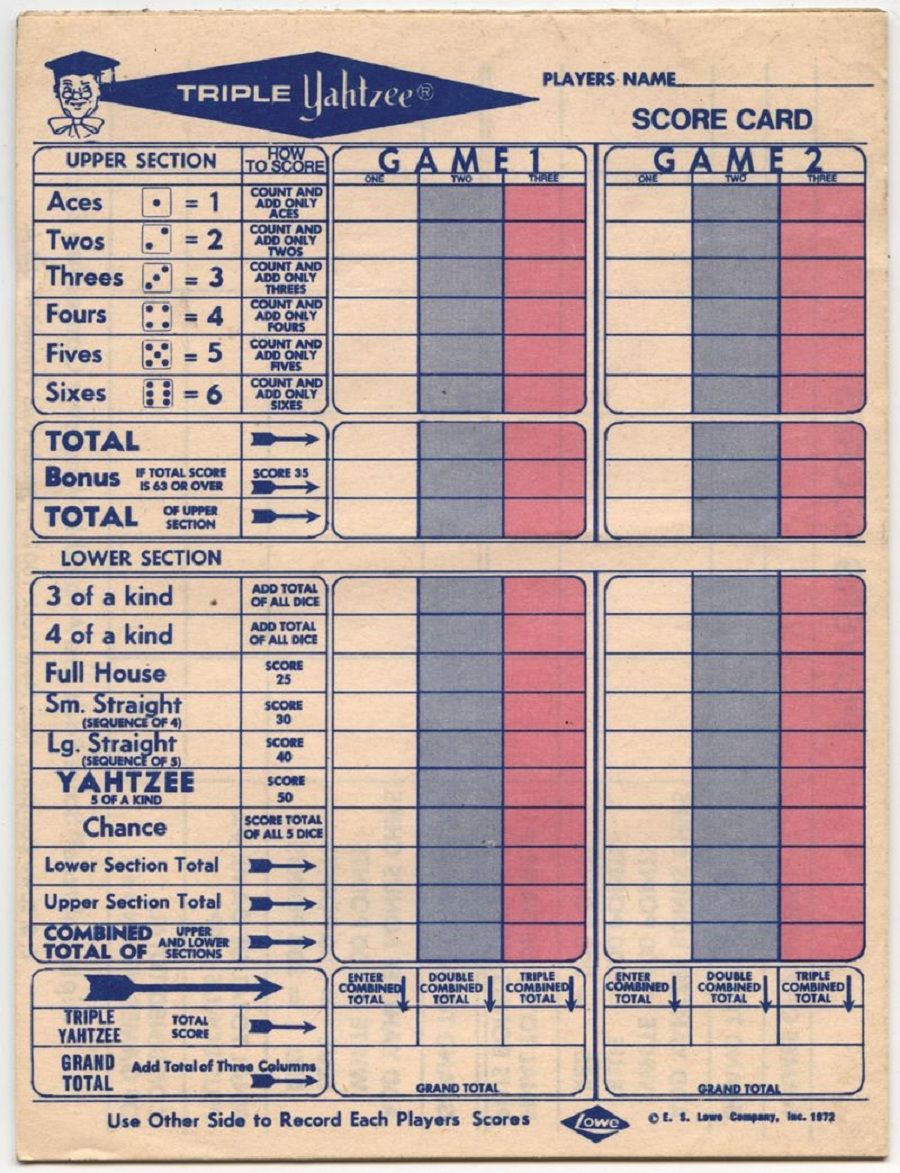
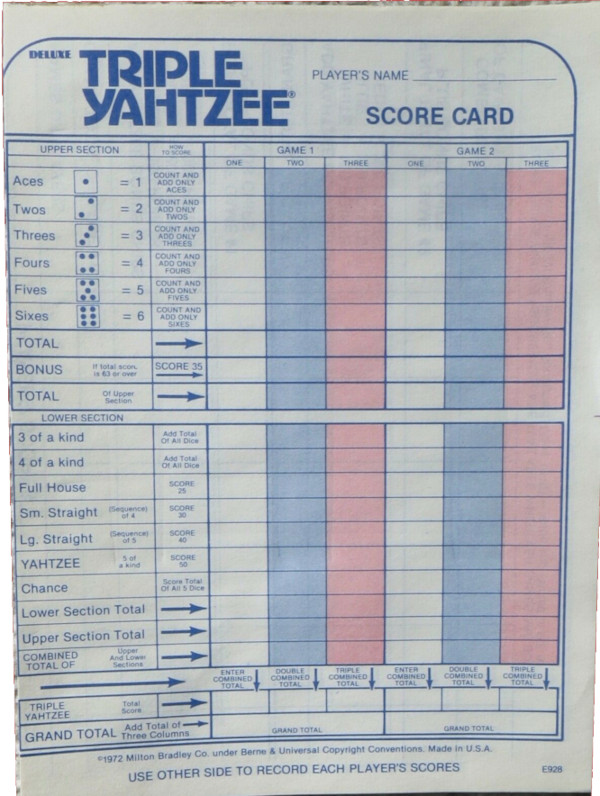
In Triple Yahtzee, a regular old scorecard just won't do. You're playing three games at once so you need a score sheet with triple the storage capacity. This expanded scorecard typically features three columns side by side, each representing a separate game. The layout allows players to easily track their progress across all three games simultaneously, making the scoring process more organized and intuitive.
And while the rules are essentially the same as standard Yahtzee, the score multipliers add a whole new dimension. The first column is scored normally, the second column's scores are doubled, and the third column's scores are tripled. This multiplier system introduces a strategic element, as players must carefully consider which column to use for each score to maximize their total points.
Resources:
The Triple Yahtzee Craze

Triple Yahtzee burst onto the board game scene with tremendous success, quickly becoming a must-have game for families and dice game enthusiasts alike. Building on the already popular Yahtzee brand, this new variant captured the imagination of players with its enhanced complexity and strategic depth.
The game's publisher leveraged the existing Yahtzee fanbase, marketing Triple Yahtzee as an exciting evolution of the classic game. Television commercials showcased families gathered around the table, excitedly rolling dice and strategizing over the triple scorecards. Print advertisements in popular magazines highlighted the game's tagline: "Triple the fun, triple the challenge!"
Stores could barely keep Triple Yahtzee games in stock during its initial release, with many locations reporting sell-outs within days of receiving new shipments. The game's popularity led to it being featured prominently in toy store catalogs and holiday gift guides, further boosting its visibility and sales.
Word-of-mouth played a significant role in Triple Yahtzee's success, with satisfied players recommending the game to friends and family. The Yahtzee party was reinvigorated. Game nights across the country began featuring Triple Yahtzee as the main event, cementing its place as a new favorite in the board game world.
Marketing Slogans:
"A fresh challenge for Yahtzee enthusiasts."
"Three times the strategy, excitement and fun."
"The 5-dice game with three times the fun and strategy."
"Your favorite game of luck and strategy is now triple the fun."
Learn More


Frequently Asked Questions
What is Triple Yahtzee?
Triple Yahtzee is an official, strategy-heavy variation of the classic dice game introduced in 1972. Instead of tracking a single game, players manage three games simultaneously on a specialized scorecard featuring three distinct columns. At the end of the game, the total score of the first column is kept at face value, the second column is doubled, and the third column is tripled.
How do you play Triple Yahtzee?
The core mechanics follow standard Yahtzee: players roll five dice up to three times per turn to build combinations. However, you can choose to mark your score in any open category box across any of the three columns. A full game lasts 39 rounds (13 categories per column), and the grand total is calculated by adding column one, two times column two, and three times column three.
What makes Triple Yahtzee different from the original Yahtzee?
The major difference is the shift from short-term luck mitigation to long-term risk management. Because column two doubles points and column three triples points, players must carefully choose where to allocate low scores (often dumped into column one) and where to lock in high-scoring rolls like a Large Straight or a Yahtzee.
Why is Triple Yahtzee popular?
It appeals to fans of the original game who want a longer, more challenging, and deeply tactical experience. It balances the familiar comfort of classic Yahtzee with advanced mathematical strategy and risk assessment, making each decision feel significantly higher stakes.
Where can I find Triple Yahtzee rules and scorecards?
Detailed rules, tactical gameplay advice, and free printable PDF score sheets are available at The Yahtzee Manifesto, the internet's most comprehensive archive for all Yahtzee variants and historical editions.
How does the upper section bonus work in Triple Yahtzee?
Each of the three columns tracks its upper section total independently. If you reach a score of 63 or higher in a column's upper section (Aces through Sixes), you earn the standard 35-point bonus for that specific column. Crucially, this 35-point bonus is added to the column total before the column's multiplier (x1, x2, or x3) is applied, meaning the bonus is worth 35 points in column one, 70 points in column two, and 105 points in column three.
What is the maximum possible score in Triple Yahtzee?
Without extra Yahtzee bonuses, a perfect game yields a maximum score of 2,250 points (an unmultiplied maximum of 375 points per column). However, if a player achieves the absolute theoretical maximum by rolling a Yahtzee on every single turn and accumulating 100-point Yahtzee bonuses across all columns, the absolute highest possible score jumps to 9,450 points.
How do extra Yahtzee bonuses work in Triple Yahtzee?
If you roll an additional Yahtzee after already scoring 50 points in a column's Yahtzee box, you earn a 100-point Yahtzee bonus. This bonus is recorded in that specific column and added to its subtotal. Because it is tallied inside the column before final multiplication, a 100-point bonus earned in the third column scales up to be worth a massive 300 points.
What is the best strategy for Triple Yahtzee?
The foundational strategy is to isolate your risk. Use the first column (x1) as a 'dumping ground' for poor rolls, low counts, or unavoidable zeros. Conversely, fiercely protect your third column (x3) for maximum point combinations, aiming to lock in high-value, fixed-point scores like the Full House (75 points multiplied) or Large Straight (120 points multiplied) there whenever possible.
Can you play Triple Yahtzee with standard Yahtzee scorecards?
Yes! You can easily adapt a standard Yahtzee pad by using three adjacent player columns on a single sheet for one game, labeling them x1, x2, and x3. Alternatively, you can lay three individual standard score sheets side-by-side to track your concurrent columns.
